
TGA Managing Editor Emma Backe interviewed Dr. Andrew Alan Johnson, an anthropologist who also serves as the Senior Historian for Sid Meier’s Civilization VII. They talk about working in the gaming industry, infusing anthropology into narrative gaming mechanics, and what it means to do “weird anthropology.”
Dr. Johnson, thank you so much for talking to The Geek Anthropologist. Can you tell us a little bit about your background?
I’m Andrew Alan Johnson, both an Associate Professor of Social Anthropology at Stockholm University and a Senior Historian at Firaxis Games. I’ve had a kind of dual life between games and academia. I got my PhD from Cornell University in 2010 in Cultural Anthropology with a specialization in Southeast Asian history, and have worked a number of places afterwards: Columbia University, Princeton, Sogang University in Korea, Ashoka University in India, and for a while in the short-lived Yale-NUS College in Singapore.
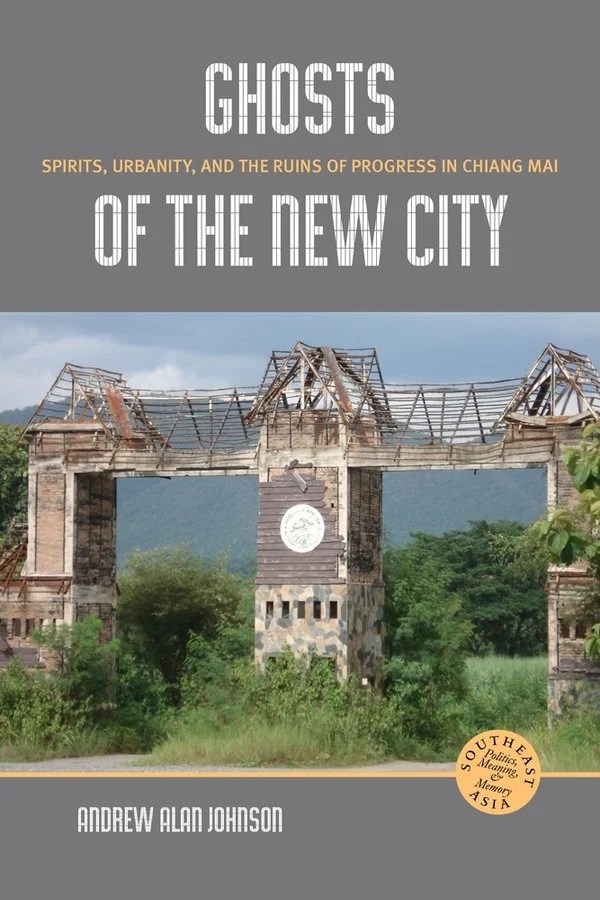
My academic work is concerned with disaster and excess. By that, I mean how people experience calamity in ways that can challenge what we understand as space and place – what exceeds the definition. It’s better with examples: the Asian financial crisis of the late 1990s led to a rash of abandoned buildings all around Chiang Mai. This is a clear story of overspeculation, of property bubbles, of newly rich Bangkokian investors buying up land and building way beyond their means in the northern city. But it’s more than this – the sites are also haunted. I take those stories of haunting and look into the relationship between Chiang Mai and Bangkok (a relationship that one could see as internal colonization), between imagined progress and its eventual failure, and the questioning of “development” as some kind of inevitability. That led to Ghosts of the New City (2014). Then, I did my second book on the Mekong, looking at similar questions in the wake of hydropower projects that led to an alteration of the river, how it worked, and what lives in it, via a deep ethnography of Thai-Lao fishers. The river is not just flow and fish; instead, it’s also a relationship with beings that also exceed our understanding – nagas, spirits, etc., but also who speak to potential, to “maybe.” This turned into Mekong Dreaming (2020), and I’m now working on a new project pulling from these two and trying to turn that idea of open-ended, incompletely-understood potential into something else (see “Encounters at the Edge of Night” in Cultural Anthropology).
But that’s the academic view. Since 2020, I’ve also had a foot in games. I grew up with games, like a lot of people of my generation – Dungeons and Dragons, Star Control, Master of Orion, Ultima, Thief, and way too many. They were kind of a comfort for a nerdy kid who always felt out of place in a hyper-masculine, hyper-conservative southern town – an escape before I could actually escape. But starting in 2020, I was hired on by Firaxis to be a historian on Sid Meier’s Civilization, and I’ve done some contract work with Paradox on Crusader Kings 3 as well. I was part-time in academia for a few years, then went back to academia full-time and now do contract work part-time on games. It’s a lot. I compensate by having little to no social life.
You’re a cultural anthropologist who predominantly works in Thailand but you’re also working as the Senior Historian for Civilization VII. What brought you to working in the gaming industry?
Both the games industry and academia are in a rough state at present. It’s like putting your foot on two ships that might sink at any minute – yes, nothing is stable, but if one starts to go down at least you have a chance on the other. That’s what it was for me; my tenure prospects had hit a snag, and so I started to look around for other options as a way to get a fresh start somewhere.
Firaxis was also looking to expand its historical expertise, so it was a pretty fortunate time. The earlier Civilization (“Civ”) games had taken a kind of shallow read on history, but as the games grew more and more complex (Civ has been running since the early 1990s), they started to run into the limits of what a lay history enthusiast could deal with. At the same time, the player base expanded to include a much more diverse audience, who demanded a better representation for non-Western histories.
So it was a confluence of things: I needed employment, and Firaxis needed an academic. I long had feet in a few different communities – like any anthropologist, I had pretty broad interests outside of academia. Games were always one of these, and I had friends scattered across a few game studios just like I have friends scattered across different universities. One of these was Zach Bush – a writer (and now narrative director) at Firaxis. He had been consulting with me with questions about especially Southeast Asian cultures for Civilization, and when the management at Firaxis was speculating that they needed a professional academic on staff, he floated my name.
This is the way that I found a lot of the games industry works – personal connections matter far more so than academia. It’s difficult to get in the door without a personal introduction – although it certainly happens (the historians that we hired after me were largely new to the industry). Being known at Firaxis has meant getting links with other studios as well – you want to have your name be on peoples’ mind as they run into a problem you might be able to help with.
I worked on the tail end of Civilization VI and have been working on VII since its development, since 2020. In 2023, I went back to doing Firaxis work part-time as I went full-time at Stockholm University. A tenured academic position is just too tempting a thing to pass up.
For those who might not be familiar with the game, can you tell us a bit more about Civilization VII?
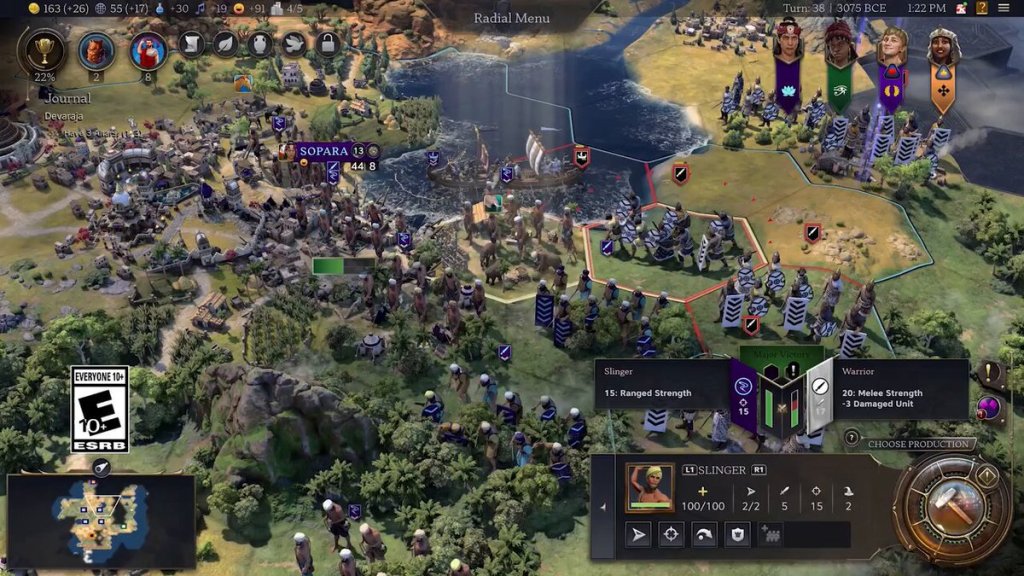
The Civilization games are a sub-genre of “grand history” strategy games, where you’re simulating – or playing with – global history for a very broad span of time. You take charge of a polity at a point in history and try to guide it through all the vicissitudes of history.
There are a number of other games in the genre, and each does something a little different. Paradox Interactive (for whom I’ve also done a bit of work) makes games focus on simulating historical processes, really getting into how different societies worked and having history or alt-history play out on the map. There’s one that’s a deep dive into feudal politics, one that’s about colonialism, one that’s looking closely at 19th century economics, etc. These are not “games” in that you’re not on equal footing with other players – depending on who you choose to play, your goals might be very different: play as a travelling poet across 10th century Tibet, destroy the Papacy as a Viking kingdom, build a Mississippian state that can resist European colonialism, etc.
Civilization (“Civ”) is a little more of a traditional game than this. You choose a civilization and a historical leader, but each player starts on an equal footing as every other – there’s less of an attempt to simulate history in this way, and more of a game that one can have a defined victory. You can win a few different ways – you can have the most vibrant culture, the most advanced technology, or you can win by conquest. Your strategy is up to you.
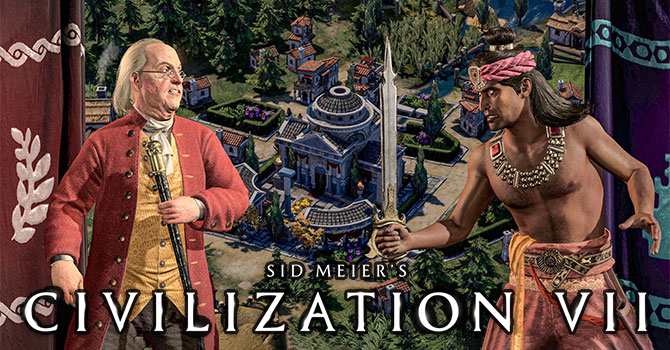
As I mentioned, you also choose a historical figure – a leader – in the game. These are figures like Benjamin Franklin, Harriet Tubman, Ashoka, Catherine the Great, Trung Trac, Tecumseh, among many others. So, for instance, I might play as Ashoka of Maurya and face off against Hatshepsut of Egypt and Augustus of Rome, even those these characters lived in very different times. It used to be that the leaders were tied to particular civilizations, but in Civ 7 we de-linked these to allow for new combinations and to bring in figures that might not be political leaders, but rather artists or visionaries that weren’t necessarily associated with a particular polity.
I think of the leader as the ideology that you’ve chosen, and the civilization as the infrastructure. So if I choose Ashoka and Khmer (an ahistorical combination, of course), I’m going to have a peaceful focus on growth and prosperity, along with cities that adapt well to floods. If I choose Genghis Khan and Mongolia, I had advantages to mounted warfare (but I can be peaceful if I like).
It’s more “history flavored” than “historical simulation”. But in the areas where there can be accuracy (in architecture or language, for instance), we try to be as close as we can to historical verisimilitude: Khmer architecture is pretty well researched, Ashoka speaks what he would have in life, and there’s an attempt to get the personalities as recognizable as possible. In addition, there are small stories that you can find in the game, most of which are triggered by a certain situation, a certain character, or a certain civilization. I’ll talk more about this in a bit.
I was hired on as a writer, but quickly found myself doing a lot of things other than writing: answering questions from art and design, for instance. So I kind of proposed a dedicated Historian role, and we now have two full-time historians on staff who do this sort of work.
Describing what I do means describing in general how things work in a game studio. You’ve got different departments that are focused on different aspects of the game. Design, for instance, makes sure that the game works as a game: the pacing is right, the numbers work out, and ultimately that it presents fun challenges to work towards: how do you win, what interesting challenges might you face? Where I might work with them would be in deciding what cultures and figures are interesting for the game and how these might work in terms of design. For instance, we have three versions of Japan in the game: a Heian-era civilization, a Sengoku-era civilization, and a Meiji-era one. Each of these are radically different historical moments in Japanese history, and it’s my job to talk to design about these times and work with them to get to a gameplay that both feels historically right and is fun. Heian, for instance, is historically a time when a elites turned inward – we have beautiful writing and art from that time, amazing city planning, but a great deal of rural neglect. How might this work in a way that is playable? What historical figures should pop up in your civilization?
Art is the other department we work closely with. What should Heian-era soldiers look like? Poets? Diplomats? Buildings? Sometimes this requires some creativity, especially with places where the historical record is scarce, or where the categories that the game uses don’t exactly fit. For instance, if you’re in the ancient era and research literacy, you can build libraries to increase your scientific knowledge and house works of writing. But we have a few civilizations in the game who did not have writing, and many where libraries as such didn’t exist. Here, I might work with art to see what a library would have looked if it had existed. I suppose another option would be to work with design and ask: if this civilization cannot develop writing, what kind of gameplay would that look like and what other strategies might a player use in that case?
Finally, the historians are housed in the narrative department. Here, we do a few different things. First of all, there’s an in-game resource with short historical articles describing each of the features in the game. There’s two pages on Khmer history, or a few paragraphs describing what a baray (Khmer reservoir) is, or the history of the library, or rocketry. If you printed all of these out, they would be several thousand pages in total – it’s really a lot. And it’s all written by someone with a PhD.
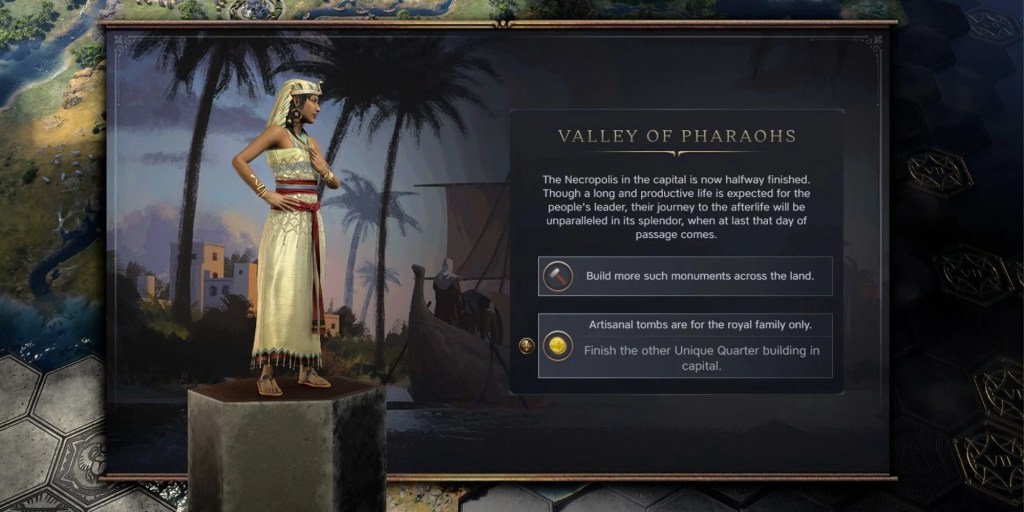
Then, there’s narrative events. As you play, the game reads what you’re doing and looks for places where we might tell a small story. Sometimes this is taken from a historical moment, sometimes it’s about the technology you’ve researched or your relationship with other players, sometimes it’s tied to the character you’ve been playing. For instance, if you’ve chosen communism as your ideology later in the game, but you’ve stuck to a monarchical government, there’s something to be said there about what exactly that looks like on the ground. Or if you’re struggling with a foreign invasion as the Mughals, you might trigger an event talking about the Sepoy Revolt that could give you an extra boost to fight back. Or perhaps it’s a larger, structural issue: the enclosure of the commons, the rise of the bourgeoisie, industrial living conditions. These are moments where we can tell the player “this is how you’ve been playing, and this is what the society you’ve made might look like on the ground.” Sometimes these are fun, sometimes they’re tied to pushing you to play the game in a different way, and sometimes they’re ways into real history in ways that might draw players in.
There are also quotations that we display when you research a certain technology, civic, or when you build a world wonder. I try to make these as global as possible, and have each give a kind of perspective on the changes your society undergoes as a result of that technology. We have quotes by Basho, by Walter Benjamin, by the Buddha, from the Preah Khan inscription, by Suzy Eddie Izzard, from Slavoj Zizek – and then we have these quotes read by Gwendoline Christie (from Game of Thrones and Severance).
Finally, within narrative we write the leaders. Each leader speaks the language they would have spoken in life. For Ben Franklin, this isn’t difficult, but for some we really had to dig deep to find native speakers (or linguists if we’re dealing in Ancient Egyptian) and local experts that might give us a tip on language, mannerisms, etc. For each of these, we bring in another expert: often a biographer of the person or another academic with an expertise in the time period or the figure, so that we can really get something that’s based as much as the game allows on a real person.
The whole process is an exercise in ADHD. I might be writing a two-page article on Sengoku history and get asked a question like “what kind of shoes should Xerxes wear” or “does this look like an accurate Tongan ship?”
In terms of the civilizations that I work on, during the later part of Civ 6 and the early part of Civ 7, I worked on everything. As we hired more historians, we were able to divide up the work somewhat. Now, we have Finn Taylor who specializes in Scandinavian Studies and Emily Bembenick, who is a Classicist. So I leave Europe and the Middle East to them and do most of the work on Asian cultures, and we will split things where no one has a clear point of expertise.
Within the game, there’s always the chance to really advocate for one or two places that are a passion. Finn, for instance, did the writing and design consultation for Iceland; I put a lot of my own work into Siam.
What about the Civilization games appealed to you as an anthropologist? How has your anthropological training and background informed your work on the game?
I remember these games from college, and the images that I have in my mind of particular historical moments often came from Civ. So it’s tremendously influential for reaching an audience that might not otherwise be into history, and I take that job quite seriously. In that sense, working on Civ appeals to my teacher instincts more than my anthropological ones, but they’re united in the idea of introducing an audience to languages, architecture, ways of living, etc., that they might not ordinarily have heard of. This might be the only time that a person could hear something in Sumerian, or see the Serpent Mound, or read a quote by Benjamin, and it’s my hope that it sparks a greater interest that people can explore. It certainly did this for me.
It seems like a fair amount of Civilization game play involves conquest and colonialism. How does the game handle sensitive cross-cultural representation in the midst of legacies of such violence?
This is a good question, and there’s a few answers. The general point is that we take this responsibility for representation quite seriously, and we don’t do it alone. Each representation is done in consultation with historical sources, with outside experts and, where it’s really needed, with the communities themselves.
When we speak of the nastier parts of history, there’s a conflict between wanting to simulate history and wanting to do history better. How do we deal with very real historical practices that would leave a bad taste for a modern audience? In some instances, we avoid it – there is no slavery in the game, at least not explicitly. Adolf Hitler does not appear in the game (and he won’t). My litmus test is “does this thing actively cause damage today, and if we have it in the game, is it likely to be used to cause damage?” Genghis Khan’s conquest of Europe was violent, but it’s long done. Nazi imagery is still used to harm today, and so I leave that out. I don’t want to be in the situation where someone is making a harmful meme using a screenshot from a game that I wrote.
But there’s also the issue of basic game mechanics: this is a game of technological progress, expansion, and competition. To do something that prevented the player from engaging in violent conflict would be to really rethink the core of the game. However, the player can easily win without it – to make something possible is different from making it the point of the game.
Being able to play with themes and as things that you wouldn’t normally agree with is simply a part of play – we have many games where we play as face-eating aliens. So I don’t feel the need to have every player take on a role that is necessarily morally good. I’d argue that most of the civilizations that we represent here were expansionist and controlling in some sense: the Inca and the Mississippians, Ming China and the Songhai all struggled for power and control, and I might disagree with most of the leaders that we had. I’m not, for instance, going to see eye to eye with Charlemagne or Napoleon, Pachacuti or Genghis Khan. And certain figures I wrote as villains – Isabella of Castille, for instance, is a less than sympathetic character in my writing (I think, at least).
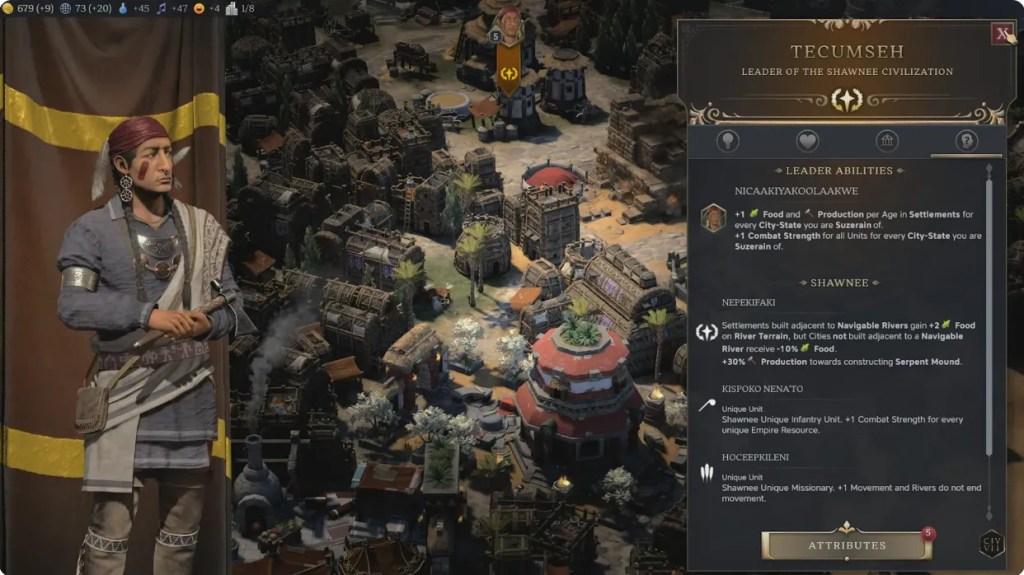
Finally, there’s the question of representation. Especially if we’re dealing with peoples who have had a history of others telling their stories, this was important. The thing I’m most proud of at Firaxis was how we handled this. We needed to have indigenous North American groups in the game – it wouldn’t be global history without them, and so we reached out to several groups when we were doing initial planning. I reached out to the Shawnee Tribe of Oklahoma and Shawnee Chief Ben Barnes. It turns out Chief Barnes is a fan of the game, and this started a long and extremely fruitful cooperation between Firaxis and the Shawnee, where members of the tribe (including Barnes and Karl Meyer) gave extensive feedback, suggestions, notes, and input into how the Shawnee were portrayed in terms of design, art, and narrative, and especially the figure of Tecumseh. We also helped fund a language revitalization school in Oklahoma for the Shawnee language. I’m really proud of how this turned out, and I think they are too. There are some great livestreams featuring the Shawnee in-studio that I encourage everyone to check out.
You can see this attention to detail, too, in the music in the game. Our music is drawn often from local performers, in local languages, and using traditional instruments (where possible).
Finally, one thing that an anthropologist can really help out with in these sorts of things is in avoiding a lot of the traps that a lay writer might fall into. Namely, Orientalism or exoticism. I found myself a constant voice reminding artists and designers to situate in a global context even what an American studio might think of as “distant” – to have modern figures from the non-West (Jose Rizal, for instance), and to feature modern versions of non-Western places (e.g. Chulalongkorn-era Siam).
You recently published the article “Encounters at the Edge of Night: An Ethnography of the Weird” with Cultural Anthropology. How would you explain to your students what you mean by an ethnography of the weird?
The weird, taken from weird fiction and philosophers such as Eugene Thacker, Mark Fisher, and Graham Harman, refers to things, objects, events, or knowledge that is unassimilable with our own everyday. In writing on ghosts, hauntings, the uncanny, etc., I encounter a lot of attempts even within anthropology to explain “weird” experiences as “really” mundane things: a ghost is a cry for unresolved justice; a haunting is anxiety coming out of economic precarity. This is insulting, I think, not only to the people that we work with and who tell us their stories, but also to our own discipline. Anthropology is unique in the social sciences in that we seek to deconstruct categories of knowledge, we seek to see the world in ways that destabilize an everyday that seems increasingly precarious in itself. Everything does not operate on the same principles of morality, justice, economics, or society – and it’s the anthropologist’s job to take apart a sense of surety or inevitability when we see it.
On the other hand, to take these sorts of experiences and make another box called “culture” or “cosmology” also misrepresents them by removing the excess or the uncertainty that they often contain.
Both of these approaches: the rationalization or the culturalization of experience does a disservice to our interlocutors: “I hear your story about seeing a ghost, but you are deluded and I know what the problem truly is” in the first case, and “I hear your story about seeing a ghost, and you are repeating your cultural world” in the second. Neither is “I hear you” and neither is “I hear you, now I will rethink my own life in your terms.”
This is what I mean by “weird anthropology” – an attempt to destabilize what we know or what we think we know, and resisting the rationalization of the world. I’m inspired here by people such as Nils Bubandt, James T Siegel, Jeanne Favret-Saada, and also am seeking here to really take seriously the perspectives of our interlocutors: not just on ‘their’ world, but on our shared world. I’m also inspired by Buddhist philosophies on “voidness,” and on Buddhist philosophy as an encounter with radical otherness – otherness that cannot be made commensurable or assimilable with our world, but at the same time cannot be excluded. And, as with Buddhist theory and contra much weird fiction, I think this is not a path towards horror or alienation, but towards empathy.
What is appealing or provocative to you about an ethnography of the weird, especially drawing upon the literary genre of the weird and applying to ethnographic research? Do you have a favorite piece of weird media?
I think what Nagarjuna refers to as “contradiction” is where I find a potential in the weird: here is something that contradicts the way that I understand the world. We should leave an anthropological encounter destabilized, with what we think that we know about the way the world works, what should or shouldn’t be, or who we are fundamentally altered. It’s a part of the anthropological insistence on empathy and connection that has been so core to our discipline for so long. One does not leave a friendship or a love affair the same as when one began it; why should fieldwork be different?
As far as the weird goes, I would have to recommend the films of Apichatpong Weerasethakul. Apichatpong brings to life Isan (Northeastern Thailand) worlds in ways that feel both natural and entirely destabilizing. Cemetery of Splendour, for instance, is a good one, or Uncle Boonmee Who Can Recall His Past Lives. In each, the viewer is lulled into a world where the boundaries and rules of the world seems incomplete, yet at the same time utterly real.
Do you have any advice for social scientists who might want to get work in the gaming industry?
I’m asked this a lot. My first caveat is that the gaming industry now is not the gaming industry that I entered. Covid injected a lot of money into the industry (because everyone was at home playing games), but now there is a bit of a hangover as companies try to keep their profit margins high despite people having other things to do with their free time. In addition, the rise of AI has meant a rise in the cost of game systems and a movement of investor money away from games and towards data centers (and things like this Copilot tool that is constantly asking me if I want it to write these answers). So times are hard, as they are hard in academia. Layoffs are constant.
But advice: cultivate an interest. The kinds of credentials you may know in academia aren’t going to be translatable into games. No one will care where you did your PhD, and no one will care who your advisor is. Having written fanfiction will be equally as prestigious as having written for Cultural Anthropology. Try to see your CV in the way that a game studio would see it – look for relevance. If you see relevance and are worried a studio won’t see it, underline it. Make it clear what you can offer, in concrete terms.
That said, also get interested! Play games, make mods for games, get opinions on games. Have a take on pacing in Stellaris or environmental storytelling in Subnautica. Develop a passion for Norco or Kentucky Route Zero. I came to Firaxis having been a consultant, but the historians we hired after me all had some kind of games-related skills: making mods, writing academic pieces on games, etc. It’s not an industry to break into if you aren’t already within the fan community in some way.
Anthropology is a decent start to this, as we all have some other kind of interest – this, after all, is bricolage.


