
By Steven Dashiell
Tabletop role playing games (TRPGs) have been around for over a half century but have experienced something of a renaissance in the twenty-first century, with new generations of players embracing games like Dungeons & Dragons (D&D) with fervor. As popularity grew, so did visible outcroppings that merged love of tabletop games with the technology and multimedia realities of the day. This expansion in tabletop gaming has also led to the rise of what is known as actual play (AP), which “record[s] a group of people playing a role-playing game [which] contain a blend of company and personal interaction with freedom and flexibility in how the players achieve their goals” (Blau 2023:32). Perhaps the best known example of actual play is Critical Role, where Matt Mercer leads a group of friends through his D&D-like world while countless fans watch on platforms like YouTube.
Simply put, actual play centers around the tabletop playing experience, combining an appreciation of the narrative that occurs in whatever game is being played with the effort of play that occurs between the people at the table. By recording the gaming experience, the audience of actual play (AP) gets to experience the excitement of both the characters and the players in one forum, without explicitly participating themselves. It is worth noting that many actual play games do allow some measure of participation, such as active comment streams that AP characters may pay attention to, or situations where donations can provide changes to the game (e.g. weapons, extra chances, etc.).The broad definition of actual play does not necessarily exclude circumstances where groups record their games for their own edification (and not necessarily an audience). It is, however, the entertainment-oriented form of actual play that has garnered the most notice, both within and outside of the gaming subculture.
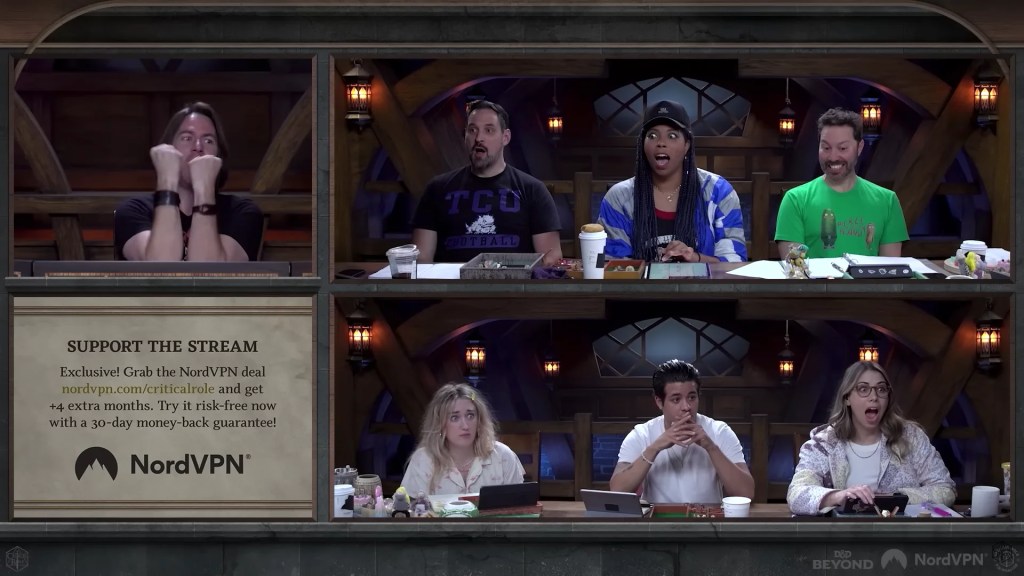
As a social scientist who has played TRPGs for more than three decades, I have to admit to some shock at the rise of actual play. More than a few friends have heard me say, “if you would have told me fifteen years ago that people would be tuning in feverishly to watch other people play a tabletop game, I would have laughed in your face.” Why? Because tabletop gaming is conventionally or publicly understood to be ‘boring,’ at least for anyone who is not participating. Thus, my interest, as someone very interested in language, was to parse out the popularity of the genre, which is deeply based on an imagined reality created by dice, imagination, and a shared conversation between multiple people. As a linguist who does as much with sociolinguistics as I do with linguistic anthropology, I’m interested in how language plays a role in the construction of players and characters in the culture of actual play. I want to explore how discourse analysis can help us to understand some of the linguistic phenomena and intention involved in this popular form of tabletop gaming.
I want to dwell briefly on why actual play and tabletop gaming has gotten so popular recently. Of course, one cannot deny the popularity of Stranger Things, and its ability to take a view of tabletop in gameplay that is both inviting and exciting. An easy procedural answer would also consider how the theatrics surrounding actual play are akin to reality television, another popular multimedia genre. Scholars have noted that actual play is a space “where the centuries-old pleasures of oral storytelling meet the modern fascination of reality television” (Alberto and Friedman 2025). In so doing, these games can have a “transformative effect on the culture and industry of TRPGs” with the success of AP productions like Critical Role (Chalk 2023:450). The goal here is to look at components of actual play to parse out at least one interpretation of what attracts its large audience. There is no one answer, but a phenomenological approach—which examines the lived experiences of people from their perspective and centers elements of importance to them—can provide us insight on its appeal, persistence and evolution.
Given that I study language and discourse, I think there is something more going on than simply the joy of watching people play, no matter how devoted, or “into” their characters they happen to be. Falling back on my sociological and anthropological roots, I believe three concepts provide more insight into what is going on with the rising popularity of actual play and lead me to a place that offers a different answer than “actual play is similar to reality television”, a statement that is appearing in certain corners of game studies (Blau 2021, Dandrow 2021). First, I want to note how the duality of the active participants affects the interest in a game.
Effectively every person in actual play is actually two social constructs (at minimum): a player (the person sitting at the table and being seen and heard by the audience) and a character (the game identity of the individual, who is being portrayed by the player). Thus, when audiences experience episodes, they don’t have to divorce the player from the character – they can enjoy each as different sources of social input, or if they choose, they can conflate elements of the player with portions of the character (such as when one person is playing different characters). What that means is that players have to go through a degree of what Erving Goffman (1959) notes as impression management, where individuals influence how they are seen by others. In a prior piece at The Geek Anthropologist, I noted how impression management was important to “keep up appearances” in Zoom meetings during COVID. In actual play, the dynamic is different: impression management is done to maintain a distinction between the player and the character, particularly when you are seeing one person. Discursively, this is done through variation in pronouns, between first- and third person. For example, does the person at the actual play table say, “I open the door” or “Sedaris [their character] opens the door.” The player has the choice, and never loses the ability to step inside their character completely, or distinguish themselves as a player from the character (perhaps when the character is doing or saying something that the player would not). While Sean Hendricks (2006) noted how players alternate between first and third person in normal TRPG games, in actual play this modulation allows for recognition of the player and the character for the audience. The main difference is that there is more intentionality in this shifting because they know that another audience is watching
This effort can be enhanced by style shifting, where individuals modulate between different styles of speech based on social circumstances (Eckert and Rickford, 2001). This style shifting—a term in sociolinguistics that refers to the modulation between different ways of speaking—can be conscious or unconscious, as social circumstances allow (Beebe 1980). This is different from code switching, which in sociolinguistics is modulation between two or more languages (though at times, people outside academia use the term “code switching” to refer to what is actually style shifting). In actual play, style shifting is deliberate as characters can take on different mannerisms, accents, voice tone: essentially the player has the ability to develop a completely different register, or repertoire of language, for their character (Halliday and Hasan 1976). While gamers outside of actual play have done this for decades, in the viewed or public space of actual play style shifting takes on a different meaning, as it allows for the audience to aurally differentiate between the player and the character. The style shifting of language, tone, accent or other factors can clearly mark the communication as “the character,” so the audience might more clearly interpret their actions and responses as distinct from the player.
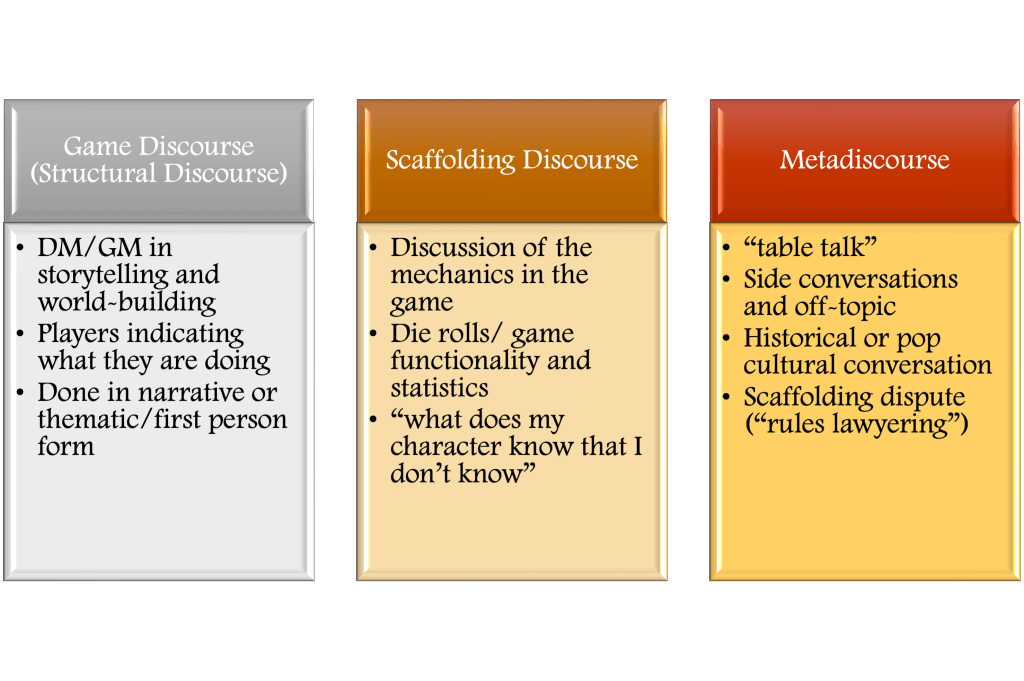
Lastly, layered discourse, or multiple levels of conversations occurring in the same social space, allows for different types of discourse to occur at the table to be recognized and appreciated by the audience. Specifically, I want to focus on two concepts: scaffolding discourse and metadiscourse. Scaffolding discourse is “where players engage in a conversation with the game master relating what their character does, and the mechanisms that allow the character to do this” (Dashiell 2020). For instance, if a player needs clarification on the rules of a game or wants to talk through strategies with others around the table, they would engage in scaffolding discourse. This scaffolding discourse is distinct from their voice and persona as a character in the game. Yes, the game is part storytelling, but some of it is dice rolling, descriptions, and rules adjudicating what is necessary for the game to progress. For example, a gaming party may need to go from one town to a city a hundred miles away. The discussion of how they get there, and what they need to get there, and how long it would take based on different movement speeds is a part of the process. Normally this conversation can be tedious for watchers, but in actual play scaffolding discourse is made more exciting with theatrical elements of comedy and performative improvisation (MacCallum-Stewart 2024). These elements invite the audience in, particularly to a conversation that serves the players as a reference group. Thereby, those discourses may be entertaining, rather than a dull discussion of rule and practice. Additionally, these conversations could be instructive for new audience members who might be new to the game or the show/podcast (given some actual play troupes have adapted or “homebrewed” systems that may be unfamiliar).
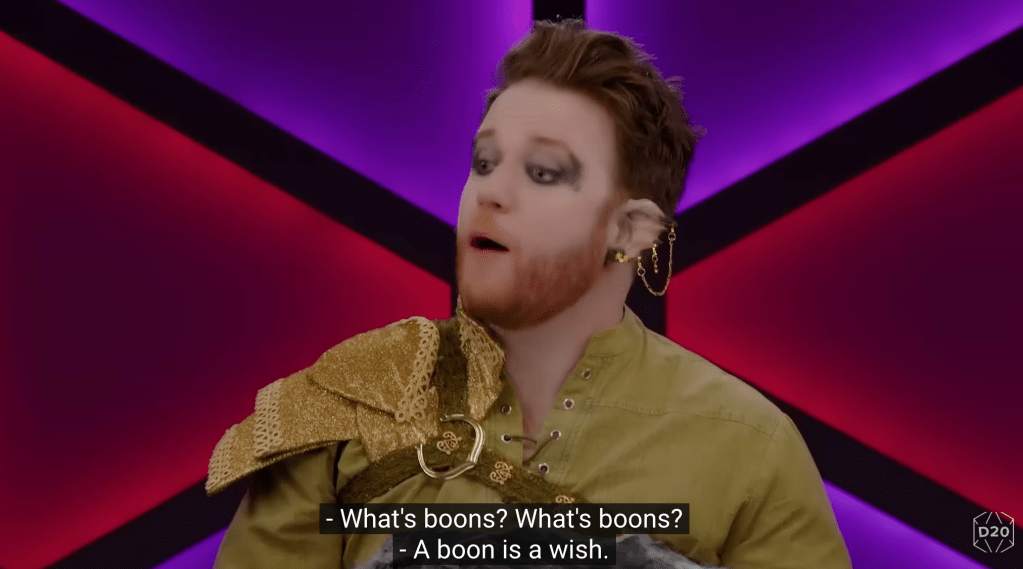
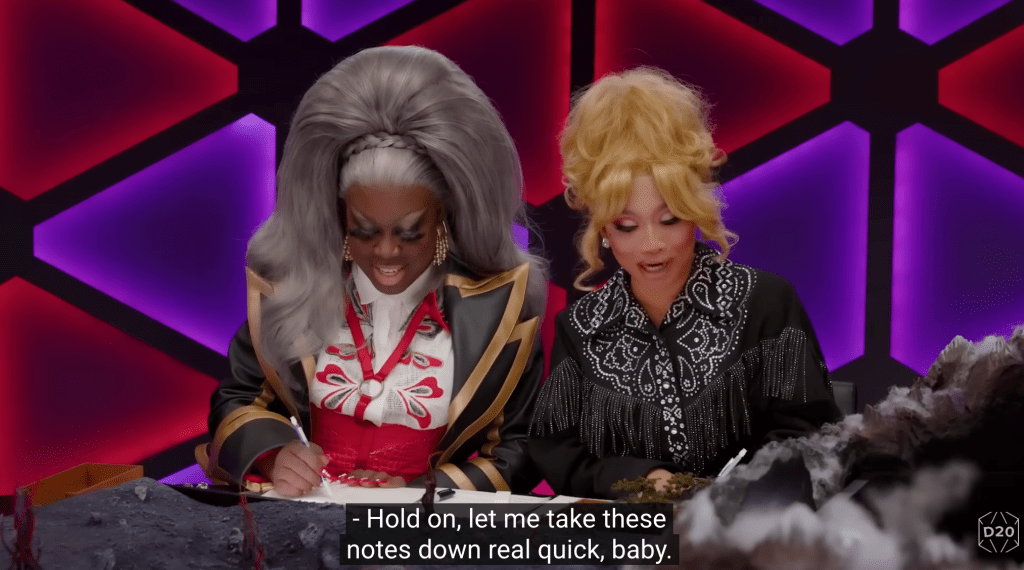
Similarly, metadiscourse is communication between players that is not critical to the game but would not occur if not for the gaming scenario, or conversation that is not necessarily germane to the game but would not occur if the game did not occur (Dashiell 2021). An example would be an encounter with a goblin during a game, which leads to a conversation about how goblins are portrayed in Critical Role. The in-game experience served as a touchpoint for a related, but tangential, conversation. Metadiscourse allows for off topic conversations that could be distracting in a regular game but serve a role of inviting the audience into the reference group in actual play. Through discussions of past games, anecdotes, and pop culture references, the audience has the potential to feel connected to the players and gain a level of appreciation for the players of the game, in addition to their characters, because the audience can remember these past experiences. As my own research suggests, the more cultural capital (or accumulation of things and concepts of value) one can amass, the more social capital (connections and interrelationships) one can gain within a field of production. The off-topic conversations that are a part of metadiscourse serve as a mechanism to demonstrate cultural capital to gain greater social capital from the wider audience.
The linguistic features of actual play are firmly settled in social and discursive constructs we see at the gaming table, though some are exaggerated because of the presence of an audience. Thus, people at the table might be more bombastic, or funny, or visibly outraged because of how it draws in those who are watching. But is actual play closer to reality television or theater? My assessment is that actual play shares a lot of DNA with live-action roleplaying (larp), which is very similar to reality television. J Tuomas Harviainen (2011) speculated that larp has three mandatory criteria: (1) Role-playing in which a character, not just a social role, is played; (2) The activity takes place in a fictional reality shared with others. Breaking that fictional reality is seen as a breach in the play itself; (3) The physical presence of at least some of the players as their characters.
My assertion is that while some might see the “fictional world” as the imaginary game world that is being generated through play, there is a level of fiction at the actual play table itself. These are similar characteristics that we see in reality television, which is why it is easy to draw parallels between the two genres. Thereby the language features like scaffolding discourse and style shifting help to support a bifurcated role for everyone at the table, to be two selves, both in a state of performance. So, yes, you are watching one actual play, but you are hearing, effectively, two distinct conversations, which provides both audience members and researchers such as myself multiple layers to examine in the linguistic anthropological study of actual play specifically, as well as tabletop gaming more broadly.
Works Cited
Alberto, M. K., & Friedman, E. C. (2025). “In focus introduction: Actual play as actual art.” JCMS: Journal of Cinema and Media Studies 64(2):150-155.
Beebe, L. M. (1980). Sociolinguistic variation and style shifting in second language acquisition 1. Language learning, 30(2), 433-445.
Blau, J. J. (2021). “Birth of a New Medium or Just Bad TV?” In Jones, S. (ed). Watch Us Roll: Essays on Actual Play and Performance in Tabletop Role-Playing Games, McFarland. pp. 32-53.
Chalk, A. (2023). “Mapping an online production network: The field of ‘actual play’ media.” Convergence 29(2):449-466
Dandrow, (2021). “Critical fails: Fan reactions to Player and Character Choices in Critical Role”. In Jones, S. (ed). Watch Us Roll: Essays on Actual Play and Performance in Tabletop Role-Playing Games, McFarland. pp. 118-135.
Dashiell, S. (2020). “Hooligans at the table: The concept of male preserves in tabletop role-playing games.” International Journal of Role-Playing (10):26-39.
Dashiell, S. (2020). “’I’m All I Wanna Be’ – Video Self Presentation in the age of COVID-19.” The Geek Anthropologist https://thegeekanthropologist.com/2020/07/15/im-all-i-wanna-be-video-self-presentation-in-the-age-of-covid/
Dashiell, S. (2021). “’Table Talk’: Defining Metadiscourse of Analog Games.” Acta Ludologica 4(2):96-107.
Eckert, P and Rickford, J (2001). Style and sociolinguistic variation. Cambridge, UK: Cambridge University Press.
Goffman, E. (1959). The presentation of self in everyday life. The Overlook Press.
Halliday, M. and Hasan, R. (1976). Cohesion in English. London: Pearson
Harviainen, J. T. (2011). “The Larping that is not Larp.” Think Larp, Academic Writings from KP2011 (172-187). Copenhagen, Denmark: Rollespilsakademiet.
Hendricks, S. Q. (2006). “Incorporative discourse strategies in tabletop fantasy role-playing gaming.” In Williams, JP, Hendricks, S and Winkler, W.(eds) Gaming as Culture: essays on reality, identity, and experience in fantasy games. McFarland, pp. 39-56.
MacCallum-Stewart, E. (2024). “’You’re Going To Be Amazing’: The Mercer Effect and Performative Play in Dungeons & Dragons.” In Sidhu, P., Carter, M., & Zagal, J. P. (Eds.) Fifty Years of Dungeons & Dragons. MIT Press. pp. 121-140.
 The Geek Anthropologist
